


From the Desk of AgFi’s Business Strategist
Published 5/8/25 – Yesterday afternoon, the Federal Reserve’s Federal Open Market Committee (FOMC) announced their decision to keep short-term rates unchanged. Chairman Jay Powell explained that uncertainty is high but that economic reports and buyer behavior are still reasonably strong. Given that, he believes the best approach is to wait to see if the environment changes. Thus far, the bond market has reacted reasonably well.
The FOMC is responsible for setting the overnight Federal funds rate (the rate at which banks lend to each other). That rate influences short-term borrowing costs. Beyond that, the market’s perception of the likely future path of the FOMC is what drives long-term interest rates.
The uncertainty created by the novel trade approach of the current administration has kept the market on edge. It’s clear that the administration has long-term goals to improve the US trade deficit and boost US economic growth. However, the angst occurs because, in the short-term, businesses need to adjust to an uncertain future.
As of now, the bond market indicates that short-term interest rates will decline gradually this year. The betting is now that the next FOMC rate reduction will be 25 basis points (.25%) in July and perhaps a total reduction of 50-75 basis points (.50% to .75%) by year-end.
Even if short-term rates decline as expected, long-term rates may not decline as much. That is because a reduction in short-term rates tends to boost the economy which could lead to greater growth and credit demand in the future.
Nothing is certain. Look at the 6-month daily chart of the 10-year Treasury rate (pictured below) – the rate most important in setting mortgage loan rates. You’ll see that there has been substantial volatility in short periods of time, but over the past few months the rate has bounced in a relatively narrow range.
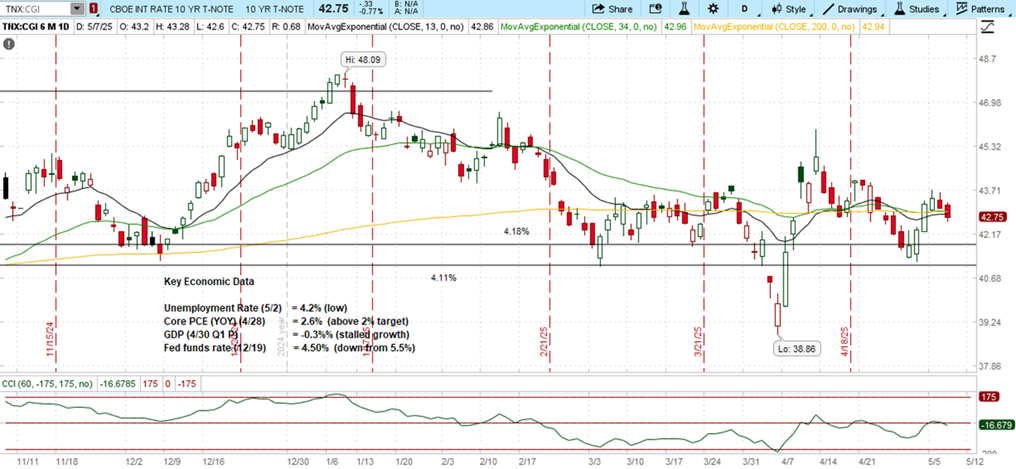
If you are looking to finance real estate, or have a real estate loan approaching a rate reset, you may want to take advantage of any instance when the 10-year rate drops below the range of 4.10% to 4.18%. It’s not likely that the rate will stay far below that level for long.