From the Desk of AgFi’s Business Strategist Published 9/18/25 – Yesterday afternoon the Federal Reserve (Fed) announced a reduction in their Fed funds rate of ¼% from 4.5% to 4.25%. That will lower the Prime rate from 7.5% to 7.25%. That is a small relief, but the biggest question is the future direction of interest rates.
With each interest rate announcement, the Fed provides a detailed summary of the projection for each of the 19 participants (7 board governors and 12 bank presidents) in their interest rate discussion. They project GDP, unemployment, inflation, and Fed funds rate. The summary showed a significant divergence in opinion, but all believe that inflation, as measured by the Personal Consumption Expenditures Index (PCE) will drop to 2% by 2027 and the Fed funds rate will settle near 3%, down 150 basis points (1.5 percentage points) from the recent rate. That would put short-term interest rates above inflation by a historically normal margin.
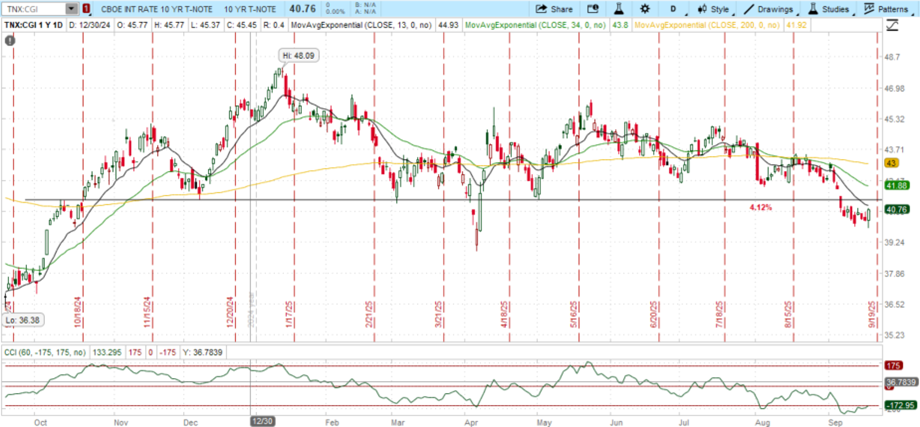
Based on historical relationships of the 10-year Treasury rate to the Fed funds rate, we can assume that if the Fed’s projections are accurate, the 10-year Treasury rate would settle near 4%. That compares to the current 10-year Treasury rate of 4.06%. That means that we should expect no material change in long-term rates over the next three years even if short-term rates drop 150 basis points.
The probability of Fed projection accuracy is not as high as you might expect. Based on historical projections, the range of Fed errors for their projection of the Fed funds rate is plus or minus 2.3 percentage points by 2027 and 2.8 percentage points by 2028. That means that the projection could be substantially wrong. Faster economic growth, or more rapid inflation, could lead to higher rates and vice versa.
The news yesterday from the Fed gives us a good idea of the direction of short-term rates over the next 6-12 months – down probably by another ¾%. But the direction of long-term rates and expectations for future rates is more in question. Watch the 10-year Treasury rate for a hint. If it stays below 4.12% (see the 12-month daily chart below) then it is likely to drift lower and support the current projection. But if it moves back above 4.12% then that is a signal that bond traders expect inflation to increase, and all rates could move higher than currently expected.